Friday, August 27, 2010

Woman Healed through Intercessory Prayer made to Mother Teresa

Mother Teresa Clipart

The following article appeared on The Times of India

A Miracle Revisited Every Day

By Subhro Maitra


KHOANAKOR, DANOGRAM, SOUTH DINAJPUR: Monica Besra does not need an occasion to remind her of the angel who would be saint. Pottering about her shabby hut, feeding her goats, stacking hay, she keeps murmuring Mother Teresa's name under her breath. It's her life's chant.

After all, she owes her life to the mother. Each day for Monica begins with a 'pronam' before the Mother's statue. It ends there as well.

The 40-something mother of five says she was cured of an abdominal tumour by Mother Teresa on September 5, 1998 the first anniversary of the the Blessed nun's death. It was recognised as a miracle by the Vatican in 2002 and led to the beatification of Mother Teresa, a step closer to possible canonisation. Monica was even taken on a tour of Vatican City in 2003.

Monica knows that the world is celebrating Mother Teresa's centenary. She does not mind that the glitter has not reached his rickety shack in Danogram, some 375 km north of Kolkata. She has been invited to one such event, though. "On the 28th of this month, there will be a special prayer for Mother Teresa at Alampur Church. Our sisters have asked me to attend," she said. "I have to go. I cannot miss an opportunity to pray for her," she said.

Monica was first admitted to Balurghat hospital with tubercular meningitis on June 11, 1998. In August, she was diagnosed an ovarian tumor. "I was in great pain. I was so weak that the doctors were afraid I would die on the operating table. They told me to return after three months. I felt so helpless," she recalls.

Her sister Kanchan took her to a Missionaries of Charity home in Potiram village, about 50km from her home. On September 5, 1998, the sisters held a special mass. That evening (Monica remembers her pain was particularly severe), two sisters placed a tiny aluminum medal blessed by Mother Teresa on her stomach, prayed over her and tied it around her waist. She dozed off but woke with a start at 1am on September 6.

"I remember the time clearly as my bed was next to a wall which had Mother Teresa's picture and a clock. I felt my stomach and was stunned to realise that the lump was gone," she said. When she told the sisters of the miracle cure in the morning, they immediately informed the church authorities in Kolkata, who instituted an inquiry into the miracle. The probe lasted from November 1999 to August 2001. In December 2002, Pope John Paul II officially attributed the miracle of Monica's healing to Mother Teresa.

This miracle' also led her to convert to Christianity. "Earlier, we worshipped Marangburu, like other Santhals. But Mother led me to Christ." Tears well up and she chokes on her words. "I often dream of Mother. I see him walking before me, leading the way. What would have happened to my children if I had died then? It was Mother's blessings that saved me and my family."

Bookmark and Share

Thursday, August 26, 2010

Orthodox and Catholic Embrace in Rimini: Signs of Christian Unity

Patriarch of the Russian Orthodox Church, Kirill, of Moscow,
and Pope Benedict XVI

Orthodox and Catholic Embrace in Rimini: May the Two Become One - International News - Catholic Online

The photograph and following excerpt is from Catholic Online:

By Deacon Keith Fournier

Full communion between the Orthodox and Catholic Churches is being prompted by the Holy Spirit. It is the most important development of the Third Christian Millennium and has implications for the whole world at this critical time in history. This coming communion between the Orthodox and Catholic Church will mark the beginning of the re-Christianizing of the West and a new missionary age.

Read More: Orthodox and Catholic Embrace in Rimini


Bookmark and Share

Saturday, August 21, 2010

History of Our Lady of the Rosary

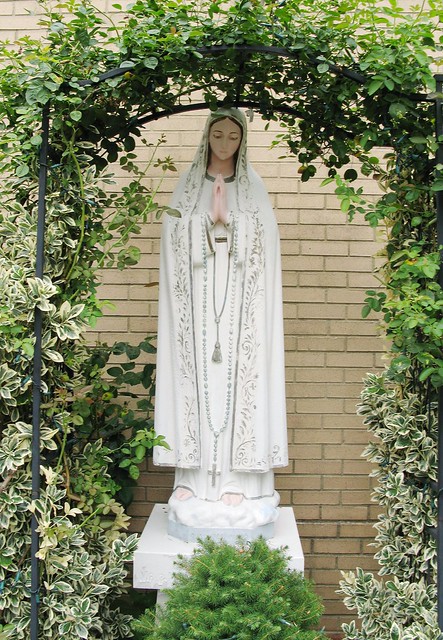
Our Lady - Photograph by Loci B. Lenar

History of the Rosary

From Wikipedia, the free encyclopedia

There are differing views on the history of the rosary. According to tradition, the rosary was given to Saint Dominic in an apparition by the Blessed Virgin Mary in the year 1214 in the church of Prouille. This Marian apparition received the title of Our Lady of the Rosary. In the 15th century Saint Alanus de Rupe (aka Alain de la Roche or Saint Alan of the Rock), who was a learned Dominican priest and theologian, received a vision from Jesus about the urgency of reinstating the rosary as a form of prayer as His Blessed Mother had requested. St. Alanus de Rupe also received the Blessed Mother's "15 Promises". Saint Alan is responsible for having many rosary confraternities. Before his death on Sept. 8, 1475 and through his devotion to the Blessed Mother, he reinstituted the rosary in many countries just as Jesus had requested. Before St. Dominic and St. Alan, however, most scholarly research suggests a more gradual and organic development of the rosary.

Prayers with beads like the rosary may have begun as a practice by the laity to imitate the monastic Liturgy of the Hours, during the course of which the monks prayed the 150 Psalms daily. As many of the laity and even lay monastics could not read, they substituted 150 repetitions of the Our Father (Pater noster in Latin) for the Psalms, sometimes using a cord with knots on it to keep an accurate count. During the middle ages, evidence suggests that both the Our Father and the Hail Mary were recited with prayer beads. In the 7th century, Saint Eligius wrote of using a counting device to keep track of the 150 Hail Marys of the Psalter of Mary. In 13th century Paris, four trade guilds existed of prayer bead makers, who were referred to as paternosterers, and the beads were referred to as paternosters, suggesting a continued link between the Our Father (Pater noster in Latin) and the prayer beads. In the 12th century, the rule of the English anchorites, the Ancrene Wisse, specified how groups of 50 Hail Marys were to be broken into five decades of ten Hail Marys each. Gradually, the Hail Mary came to replace the Our Father as the prayer most associated with beads. Eventually, each decade came to be preceded by an Our Father, which further mirrored the structure of the monastic Divine Office.

The practice of meditation during the praying of the Hail Marys is attributed to Dominic of Prussia (1382–1460), a Carthusian monk, who called it "Life of Jesus Rosary".  The German monk from Trier added a sentence to each of the 50 Hail Marys already popular at his time, using quotes from scriptures. Promoted by his superior Adolf von Essen and others, his practice became popular among Benedictines and Carthusians from Trier to adjoining Belgium and France, where it was greatly promoted by the preaching of the Dominican priest Alan de Rupe, who helped to spread the devotion in France, Flanders, and the Netherlands between 1460 and his death in 1475.

Read More: History of the Rosary

***

How to Pray the Rosary: Devotional Prayers

The statue of Our Lady is displayed outside the Church of Saint Ann in Hoboken, NJ.  Loci B. Lenar photographed the statue while attending St. Ann's Italian Festival on July 25, 2010.

Photograph Copyright 2010 Loci B. Lenar
Christian-Miracles.com

Bookmark and Share

Friday, August 20, 2010

Evangelists Say Muslims Coming to Christ at Historic Rate


Evangelists Say Muslims Coming to Christ at Historic Rate

The photograph and following excerpt is from Charisma News Online:

By Sarah Stegall

Christians ministering quietly in the Middle East say Muslims are coming to Christ at an unprecedented pace.

"Probably in the last 10 years, more Muslims have come to faith in Christ than in the last 15 centuries of Islam," said Tom Doyle, Middle East-Central Asia director for e3 Partners, a Texas-based missions agency.

A former pastor, Doyle has been to the Middle East around 80 times, and last week returned to the U.S. from a trip to Jerusalem, where he said both Muslims and Jews are turning to Christianity.

Earlier this month, more than 200 former Muslims were baptized during a training conference in Europe led by Iran-born evangelist Lazarus Yeghnazar. Brenda Ajamian, a former missionary to the Middle East who partners with Yeghnazar's 222 Ministries International, said the event was unlike anything she'd seen during her years ministering in Egypt, Lebanon and Jordan.

"That many Muslims who converted to Christ in one place boggled my mind because missionaries have worked in the Arab world and Muslim world generally for years and without much fruit," Ajamian said. "God is at work among Muslims."

Doyle said Father Zakaria Botross, a born-again Coptic priest, reaches about 60 million people through his television programs broadcast across the Middle East. "The apostle Paul to the Muslims is no question Father Zakaria," Doyle said.

But many Muslim-background believers have said they came to Christ after having dreams and visions of Jesus.

"I can't tell you how many Muslims I've met who say: ‘I was content. I was a Muslim, and all of a sudden I get this dream about Jesus and He loved me and said come follow Me," Doyle said.

Read more: Charisma Online


Bookmark and Share

Tuesday, August 17, 2010

The Faithful Traveler - Season One DVD


The Faithful Traveler Mash-Up from The Faithful Traveler on Vimeo.

The following update is from the website of The Faithful Traveler:

The Faithful Traveler is an independently produced travel series featuring Catholic shrines and places of pilgrimage.  Join the show’s host, Diana von Glahn, as she explores the glories of the Catholic Church through the art, architecture, history and doctrine behind these inspiring sites.  The TV show airs on EWTN.

A new 2-DVD set of all 13 TV episodes of The Faithful Traveler Season One is now available on their website at the following link: The Faithful Traveler

Season One Episodes:

Cathedral Basilica of the Sacred Heart, Newark, NJ

Cathedral of Mary Our Queen, Baltimore, MD

Old St. Patrick’s Cathedral, New York, NY

National Blue Army Shrine of the Immaculate Heart of Mary, Washington, NJ

National Shrine of St. Elizabeth Ann Seton, Emmitsburg, MD

National Shrine of St. John Neumann, Philadelphia, PA

National Shrine of St. Katharine Drexel, Bensalem, PA

National Shrine of St. Rita of Cascia, Philadelphia, PA

Shrine of Our Lady of the Miraculous Medal, Philadelphia, PA

Shrine of St. Elizabeth Ann Seton at Our Lady of the Rosary Parish, New York, NY

St. Alphonsus Church, Baltimore, MD

St. Mary’s Spiritual Center & Historic Site on Paca Street,
Baltimore, MD

St. Patrick’s Cathedral, Part 1, New York, NY

St. Patrick’s Cathedral, Part 2, New York, NY

St. Peter’s Roman Catholic Church, New York, NY

Bookmark and Share

Sunday, August 15, 2010

Our Lady of Mt. Carmel and the Brown Scapular

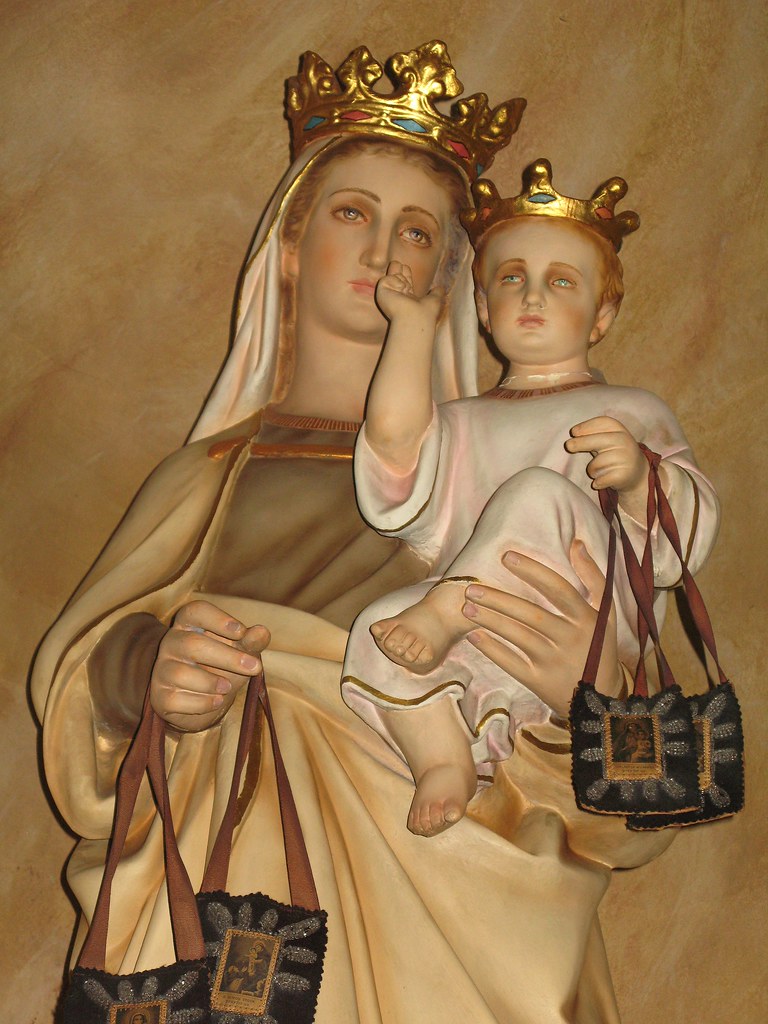
Our Lady of Mt. Carmel - Photograph by Loci B. Lenar

Our Lady of Mt. Carmel and Saint Simon Stock

The following excerpt regarding Saint Simon Stock and history of the brown scapular is from Catholic Online:

Although little is known about Simon Stock's early life, it is also believed that, as a young man, he went on a pilgrimage to the Holy Land where he joined a group of Carmelites with whom he later returned to Europe.

Simon Stock founded many Carmelite Communities, especially in University towns such as Cambridge, Oxford, Paris, and Bologna, and he helped to change the Carmelites from a hermit Order to one of mendicant friars. In 1254 he was elected Superior-General of his Order at London.

Simon Stock's lasting fame came from an apparition he had in Cambridge, England, on July 16, 1251, at a time when the Carmelite Order was being oppressed. In it the Virgin Mary appeared to him holding the brown scapular in one hand. Her words were: "Receive, my beloved son, this scapular of thy Order; it is the special sign of my favor, which I have obtained for thee and for thy children of Mount Carmel. He who dies clothed with this habit shall be preserved from eternal fire. It is the badge of salvation, a shield in time of danger, and a pledge of special peace and protection."

The scapular (from the Latin, scapula, meaning "shoulder blade") consists of two pieces of cloth, one worn on the chest, and the other on the back, which were connected by straps or strings passing over the shoulders. In certain Orders, monks and nuns wear scapulars that reach from the shoulders almost to the ground as outer garments. Lay persons usually wear scapulars underneath their clothing; these consist of two pieces of material only a few inches square.

There are elaborate rules governing the wearing of the scapular: although it may be worn by any Catholic, even an infant, the investiture must be done by a priest. And the scapular must be worn in the proper manner; if an individual neglects to wear it for a time, the benefits are forfeited.

The Catholic Church has approved eighteen different kinds of scapulars of which the best known is the woolen brown scapular, or the Scapular of Mount Carmel, that the Virgin Mary bestowed on Simon Stock. His feast day is May 16th.

***

Prayer of Saint Simon Stock to Our Lady of Mt. Carmel

O most beautiful Flower of Mount Carmel, fruitful vine, splendor of Heaven, Blessed Mother of the Son of God, Immaculate Virgin, assist me in this my necessity. O Star of the Sea, help me and show me herein that you are my Mother.

O Holy Mary, Mother of God, Queen of Heaven and earth, I humbly beseech you from the bottom of my heart, to succor me in this my necessity. There are none that can withstand your power. O show me herein that you are my Mother.

O Mary, conceived without sin, pray for us that have recourse to thee. (Repeat 3 times)

Sweet Mother, I place this cause in your hands. (Repeat 3 times)

***

The statue of Our Lady of Mt. Carmel is on display at the Church of Saint Ann in Hoboken, NJ. I photographed the statue while attending the St. Ann's Italian Festival on July 25, 2010.

Photograph Copyright 2010 Loci B. Lenar
Christian-Miracles.com

Bookmark and Share